
Working with Neurodivergent Children: A Practical Guide for Nannies
Written By Susannah Loraine — Nanny & Freelance writer
Every good nanny should tailor their approach towards supporting the children in their care based on their strengths and differences. When looking after children displaying neurodivergent traits, this individualised approach is essential. Understanding what neurodivergence is, how an individual child processes information and the adaptations they may need is key to creating an environment where their uniqueness can thrive.
What is neurodiversity?
Neurodiversity describes the natural variation in how human brains develop, process information and experience the world. People whose brains function differently from what society considers typical may describe themselves as neurodivergent.
Neurodiversity is an umbrella term encompassing multiple conditions. Some accommodations can benefit children with a range of conditions, although support should always be tailored to the individual. A child may also receive more than one diagnosis, as neurodevelopmental conditions can co-occur. A child’s presentation and support needs may change as they grow, and additional or co-occurring conditions may be recognised over time.
Some of the most common conditions referred to as neurodivergent are Autism Spectrum Disorder (ASD), ADHD, dyslexia, dyspraxia and Tourette syndrome. The neurodiversity movement embraces the differences experienced through these conditions as valuable strengths, particularly when it comes to out-of-the-box problem-solving and creativity.
Diagnosis can take place at any point in a person’s life, and the average age of diagnosis varies between the disorders. Signs of autism generally show up in early childhood, while ADHD and learning difficulties are more likely to become apparent when children start school and have to conform to rigid behavioural expectations. Some people are diagnosed in adulthood; girls may be more likely to mask their difficulties and therefore pass as neurotypical, and diagnostic criteria have typically been based on male behavioural traits.
Early signs
In recent years, awareness has grown around the different ways autism and ADHD can present. Girls and children who mask their difficulties may be particularly likely to have their needs overlooked, so it is important to understand that signs will not look the same in every child. It can be difficult to know whether certain behaviours are a natural part of your charge’s development or if it could be a sign of something that requires attention from professionals. Here, you can find a helpful table of behaviours that may suggest your charge is neurodivergent:
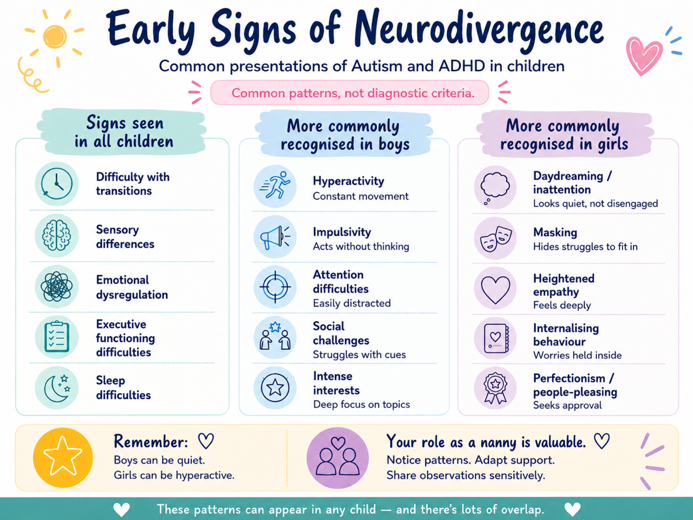
An important reminder: as a nanny you are not equipped or expected to diagnose neurodivergence in the children you look after, but noticing patterns and voicing concerns to parents forms an important part of our professional responsibilities, so that children can thrive regardless of how their brains function.
How can I plan for and accommodate their needs?
The most important thing you can do is be observant: make a note of any patterns of behaviour you notice and adapt your approach in response to them.
For example, when I looked after a child who had been diagnosed with ADHD, I noticed that he really struggled to regulate his behaviour and emotions if he was at all hungry. All children can get hangry; this was next-level meltdowns if he missed a snack. I made sure to always have extra snacks with me that I was sure he would eat.
I also noticed that if he was hungry and went into meltdown mode, he couldn’t recognise that hunger was the problem. He would refuse to eat at all. I realised that one of his favourite foods, sweet brioche rolls, had a particularly delicious smell – I would waft the brioche under his nose until he would notice the smell and take a bite. It sounds a little ridiculous, but he would immediately calm down, often sighing with relief.
I had to understand that this intense reaction to hunger wasn’t something he could control himself, and that I and the other adults around him needed to be prepared and use strategies to manage these meltdowns. So always having a pack of sweet brioche rolls on me became my strategy!
Meltdowns can be caused by so many things: fatigue, sensory overload, anxiety, hunger, unexpected changes in plans and communication difficulties. Trying to identify possible triggers can help you prevent meltdowns and respond more effectively when they occur. Communicating what you notice to parents is again so important, so that they can also be better equipped to manage them when you are not around.

Another child I look after, who we’ll call Arthur, is in the process of being diagnosed and really struggles when instructions are not explicitly clear. I have a rule: when the boys I look after get home from school, they must empty their school bags and put everything where it should be. So they would arrive home and I would ask Arthur to empty his school bag. He would do exactly that – he would empty his school bag on the hallway floor, and go off to play or have a snack. I would become frustrated, walking into the hallway to find a pile of snack boxes and books dumped on the floor. After a few days I realised that he wasn’t being lazy, or ignoring what I had asked him to do: he needed more specific instructions.
So now, I tell him “please may you empty your school bag, put the snack box and water bottle in the kitchen sink and take your books and artwork to your bedroom”. This was never an issue of behaviour or obedience – it was an issue of communication.
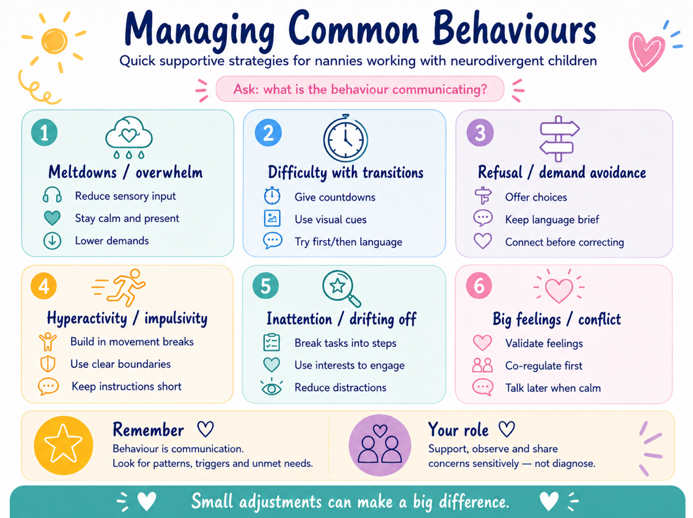
The most important thing you can do is ask yourself, “What is this behaviour telling me?”. If your charge struggles to sit still for too long, provide regular movement breaks and even find ways to incorporate movement into tasks. They need to practise their times tables? Have them bounce a ball while answering. Practising spellings? They can make the shapes of the letters with their bodies.
Here are some at-a-glance strategies you can use to manage behavioural challenges:
What should I do if I suspect neurodivergence in the children I look after?
Nannies often spend a significant amount of time with the children in their care and see them across a wide range of situations. As the child’s dedicated nanny, you may notice behaviours, patterns or differences that parents have not had the opportunity to observe or don’t know is a sign of neurodivergence.
It is important that you bring up any concerns with the child’s parents. But delivery matters. Some may be resistant to the idea of anything that might be “wrong” with their child. You must take care to frame the behaviours you have noticed not as problems, but as differences that once harnessed can ensure the child thrives.
Keeping things positive is key. Sharing strategies that you have tested out to manage meltdowns and behaviour will help parents when you’re not there and let them know that you are being proactive and that differences are manageable given the right approach. Maintain that assessment is a positive thing, as it can mean additional support at home and at school so that the child can thrive.
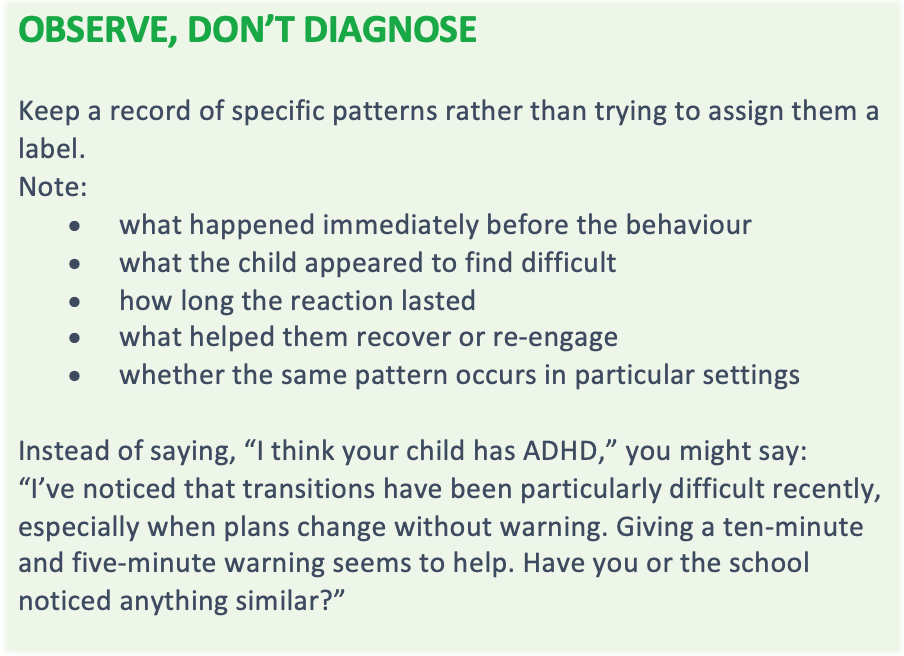
It is also advisable to share observations rather than conclusions. If you are concerned about certain behaviours then you can also ask if teachers have communicated any observations and concerns to build a clearer picture of what might be going on.
If you find yourself struggling to manage the child’s additional needs, you can also speak to your employer about undertaking specialised training to help you manage the additional responsibilities. Your employer will surely appreciate the commitment to professional development and may even want to undertake some training or guidance themselves.
Support, therapies and treatment
If your charge does get a diagnosis, the professional involved may suggest support or interventions to help based on the child’s needs. These could include accommodations at school, occupational therapy, speech and language therapy, play therapy or medication amongst other approaches.
One child I looked after was given an extra snack break at school, due to his issues regulating himself when hungry. Another did play therapy at home, while I would take another to occupational therapy appointments.
When a child in my care was prescribed ADHD medication, I initially allowed a difficult experience within my own family to influence my reaction. Looking back, I would approach that conversation more carefully. Decisions about medication belong to parents and qualified medical professionals. A nanny’s role is to follow the agreed instructions, observe the child closely and communicate any changes or concerns without creating fear around treatment.
Remember to look after yourself
Looking after neurodivergent children can be challenging, but can also be extremely rewarding. Your efforts to proactively support the child will surely be appreciated by parents, and through learning, research and experience will lead to professional development and skills which will be invaluable as you move through your career.
You may find that you need more downtime or support when facing challenges in your day-to-day work. Do not feel that you can’t bring this up with your employer; they will most likely be so grateful to have someone proactive and understanding working with their child that they will want to keep you energised, and more than anyone they will understand the challenges you are faced with.
You won’t always get it right; I myself look back to many mistakes where I didn’t understand what my charge needed, or I didn’t respond to a situation with the child or parents in a way that I would now with more experience under my belt. The important thing is that you are constantly open to learning from these experiences, and growing alongside the children you are responsible for.
Resources
There are some great resources you can turn to online for extra information and support, listed below:
https://www.nhs.uk/conditions/autism/
https://www.nice.org.uk/guidance/ng87
Want to hear more…
Head to The Training Hub on Evelyn & Bloom Connect to watch our webinar with Susie to hear her full story & the path she is now heading in to see if it might inspire you on your professional journey.
Looking for a London Nanny or Maternity Nurse?
If you’re seeking a London nanny, private nanny in London, or maternity nurse London, Evelyn & Bloom is here to help.
We offer a discreet, personalised service designed to match your family with outstanding childcare professionals.
Get in touch today to discuss your requirements or begin your search with confidence.